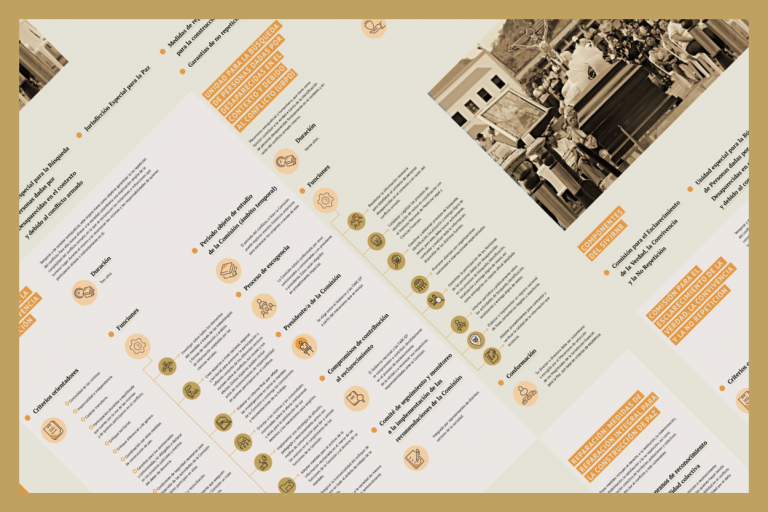
Item 5 contains the agreement regarding victims of the conflict, which leads to the creation of the Comprehensive System for Truth, Justice, Reparations and Non-repetition.
Since the very beginning of the talks, the government centered the peace process on the victims. This took shape through: i) the ten agreed upon principles to guide the discussion of victim’s rights, beginning with the fundamental recognition that they have a right to the truth, to justice, to reparations and to guarantees of non-repetition; ii) the broadening of participatory processes through three regional forums, one national forum, direct participation at the Negotiating Table, and more than 27 thousand physical and digital contributions; iii) the creation of the Gender Subcommittee, which recognized the disproportionate and differentiated impacts that the armed conflict had on women and was tasked with adopting adequate measures to defend their rights; and iv) the creation of the Historical Committee for the Conflict and its Victims that would offer explanations, from various perspectives, for the causes and complexity of the conflict in Colombia, without attempting to stand in for the process of clarifying the truth.
Based on all of this, the Comprehensive System of Truth, Justice, Reparations and Non-repetition (SIVJRNR according to its Spanish initials) was created, applicable to all those who participated in the armed conflict, and made up of different judicial and extrajudicial mechanisms aimed at simultaneously achieving, or facilitating: the greatest possible satisfaction of victims’ rights; accountability for all that happened; judicial protections for those who participate in the system; coexistence, reconciliation and non-repetition; and the transition from armed conflict to peace.
Because the system is comprehensive, its processes are interconnected in an integral way, and no single process takes primacy over another. In addition, any differential treatment under the law is dependent on contributions to clarifying the truth, to reparations, and to non-repetition agreements. Thus, victim participation is taken into consideration as an aspect of every process and petition as a way to fundamentally guarantee that their rights will be upheld.
To select civil servants for the different processes, an autonomous and independent selection committee was created along with an application and selection procedure, guaranteeing legitimacy, impartiality and independence for all of Colombian society and for victims in particular.
To fulfill the victim’s right to the truth, the SIVJRNR relies on the Commission for the Clarification of the Truth, Coexistence and Non-Repetition (CEV according to its Spanish initials) and the Special Search Unit for Persons Assumed Missing in the context of, and by way of, the armed conflict (UBPD according to its Spanish initials) as extrajudicial mechanisms that contribute, respectively, to clarifying what took place and to providing explanations for the families of missing persons. Their extrajudicial character is intended to incentivize participation by different sectors and actors by guaranteeing, through their very task, that the information participants contribute will not be used to assign fault in a judicial setting.
For the justice component, the agreement called for the creation of a Special Jurisdiction for Peace (JEP according to its Spanish initials), which fulfills the state’s responsibility to investigate, try, and penalize crimes committed in the context of, and by way of, the armed conflict, particularly the most severe and representative crimes. This jurisdiction is composed of an Executive Secretary and five bodies:
- The Chamber of Amnesty and Pardon, responsible for granting amnesties or pardons to persons under investigation for or convicted of political crimes and related crimes, which excludes: crimes against humanity, genocide, serious war crimes, taking hostages or other grave losses of liberty—for example, sequestering civilians—, torture, extrajudicial executions, forced disappearances, rape and other forms of sexual violence, forced displacement and recruiting minors.
- The Chamber of Acknowledgment of the Truth and Responsibility and of the Establishment of Facts and Conduct, responsible for receiving all of the information from various state entities; calling upon individuals, and their representatives, to acknowledge responsibility for commissioning the most severe crimes; comparing information; and rendering a summary argument.
- The Peace Tribunal, responsible for moving forward with proceedings in cases where truth and responsibility are acknowledged, as well as in cases absent acknowledgment of truth and responsibility. In accordance with the case, the Tribunal grants three types of penalties:
- Appropriate: imposed on those who acknowledge truth and responsibility. This can include work or activities to compensate damages, as well as the effective restriction of freedoms and rights, with a duration of five to eight years.
- Alternative: imposed on those who acknowledge truth and responsibility belatedly, though before the sentence has been rendered. This has an essentially retributive function of punitive privation of liberty, with a duration of five to eight years.
- Standard: imposed on those who have not acknowledged truth and responsibility and who are condemned by the Tribunal. This has an essentially retributive function of punitive privation of liberty, with a duration of fifteen to twenty years.
- The Investigation and Prosecution Unit, responsible for investigating cases absent acknowledgment of truth and responsibility and, in cases that merit such measures, accusing within the Peace Tribunal.
- The Chamber for Defining Legal Standing, charged with defining the legal standing of those who are not the object of amnesty or pardon nor have been sent to the Tribunal.
In the reparations dimension of the SIVJRNR, the agreement recognized that the end of the conflict represents a unique opportunity to strengthen the comprehensive victims’ reparations program that the state has been implementing—based on input collected from victims and their organizations through a broadly participatory process. It is also a unique opportunity to ensure that all who participated, directly or indirectly, in the conflict and caused harm shall contribute to reparations for the victims, whether through advance acknowledgment of responsibility or by concretely contributing to reparations.
Finally, the agreement established that the non-repetition dimension should be expressed: within the different mechanisms and measures of the SIVJRNR; within the measures agreed to in Item 3 regarding the bilateral and definitive ceasefire and cessation of hostilities, the laying down of arms and the program to reintegrate ex-combatants into civilian life; and within the different provisions in the areas of rural reform (Item 1), political participation (Item 2) and the solution to the problem of illicit drugs (Item 4), which contribute to reversing the effects of the conflict and changing the conditions that facilitated the persistence of violence throughout the country.